
“Alcohol Everywhere”will hurt local liquor stores, local choices for consumers, and locally-made products.
No new laws are necessary!
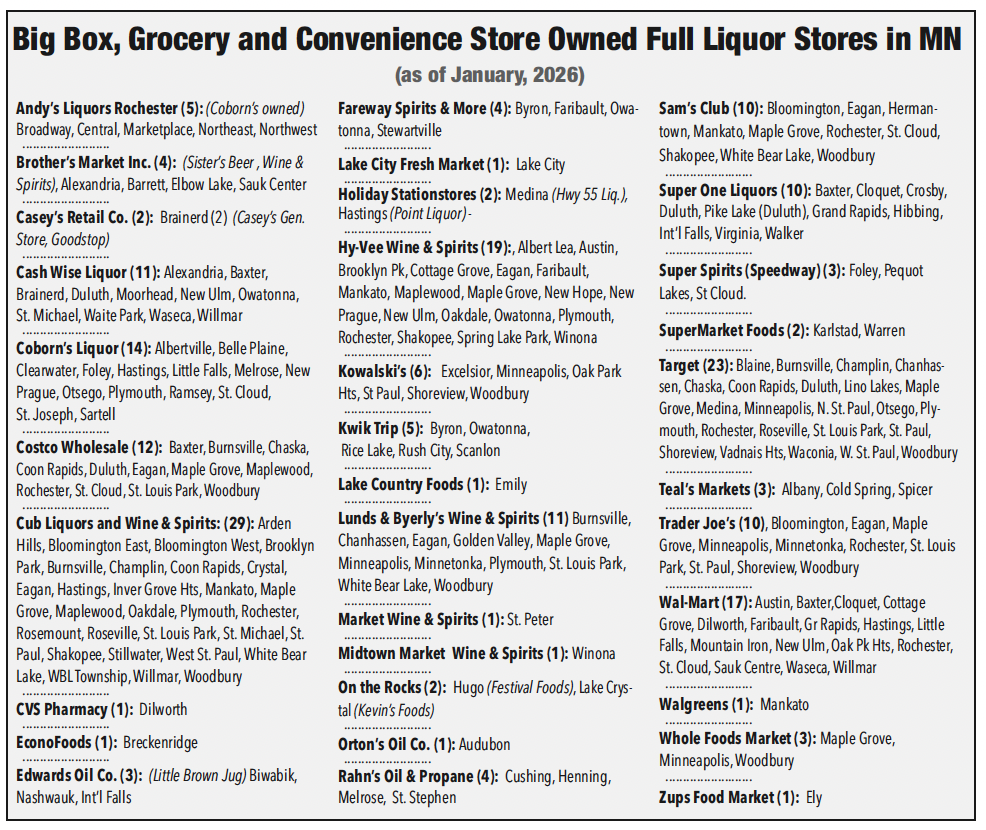
As of January, 2026, there are 223 big box, grocery, and convenience stores in Minnesota that sell full strength beer, wine and spirits. They have the same hours of operation; the same age restrictions; the same liquor license fees as private and municipal liquor stores do. If connected to the main store, they also must have a separate entrance and separate checkout from the grocery store - or what is known as the 3- door (common vestibule with separate entrances to the liquor store and main store).
The growing list of 223 big-box, grocery and convenience owned liquor stores listed below represent over 200% increase in just the last 18 years. It is undeniable proof that we can all be in business together with no new laws and a strong “three-tier” system of manufacturers, distributors and retailers.
These liquor stores have proved that no new laws are needed that would greatly increase the number of outlets for alcohol in Minnesota. The MN Smart Campaign fully supports these liquor operations.
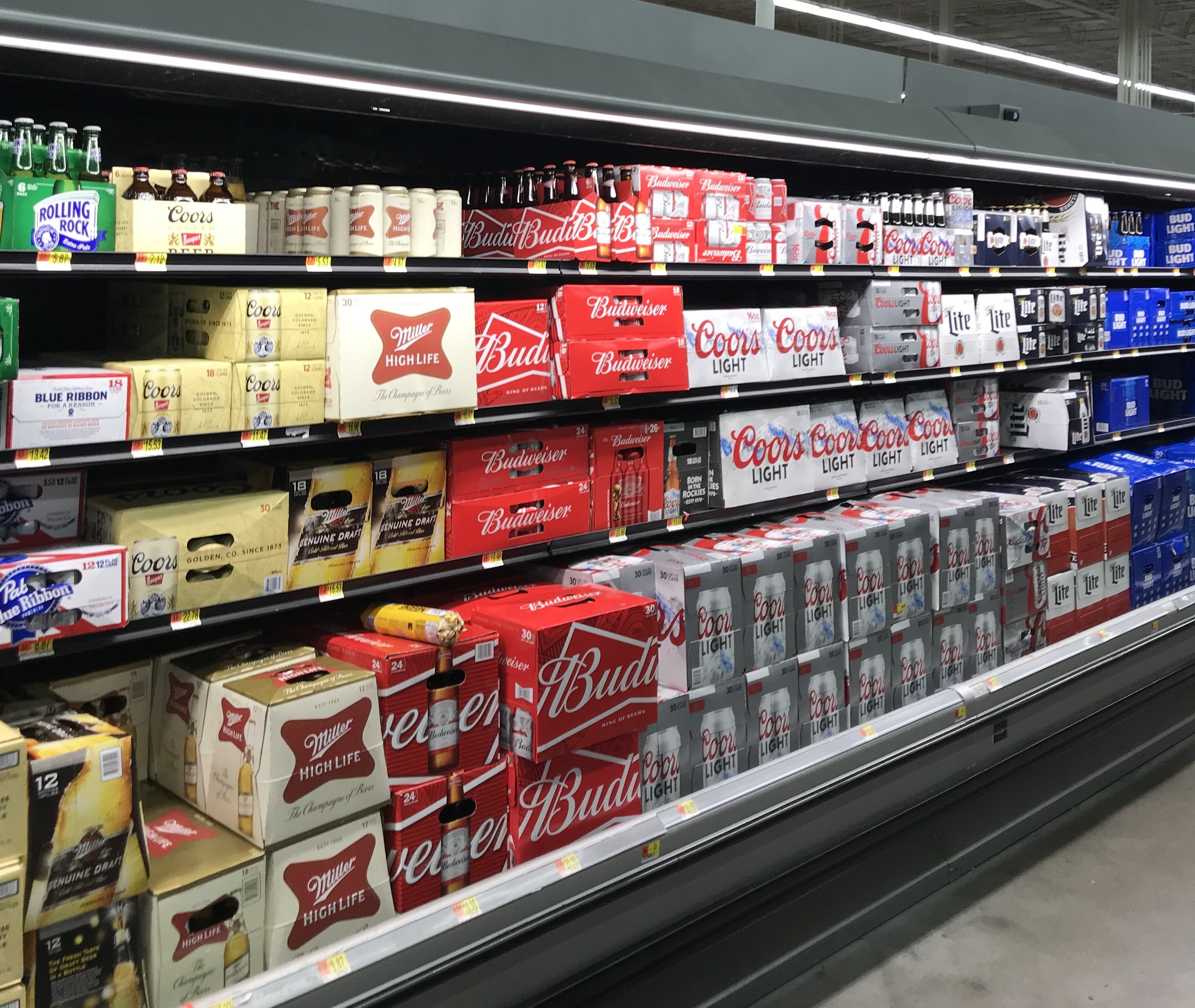
Consumers would see less variety and choices
This is what beer selection looks like in an Arizona grocery store. Minnesota consumers deserve better—let's keep our broad selection at local liquor stores.
Locally-owned businesses will close
Dozens of liquor shops shuttered after voters OK wine sales in grocery stores; hundreds more expected, January 2, 2025, Denver Gazette
Dozens of liquor shops shuttered after voters OK wine sales in grocery stores; hundreds more expected
What’s more, the state’s craft brewers say they are equally feeling the pinch — dozens have already closed or have diminished their output — because demand for their product lines has also dropped, largely the combined result of fewer local-friendly liquor stores and grocers with little appetite to offer prime shelf space to unproven brands.
“The number of stores closing or near closing is a train wreck that is happening and we can see it getting worse,” said Bruce Dierking, co-founder of Hazel’s Beverage World in Boulder and longtime proponent of independent liquor store rights. “I’d say broadly that I knew it would be bad (if Proposition 125 passed), but it’s been worse. For every independent it’s been at least a gut punch if not more devastating.”
CO: Why hundreds of liquor stores are set to close, December 9, 2024, Axios
Dozens of liquor stores are shutting down and hundreds of additional closures are expected now that wine and beer is available at Colorado grocery stores, a new analysis shows.
Why it matters: The shift - prompted by new laws and a voter-approved referendum in 2022 - created new winners in the retail marketplace and hurt small businesses.
Peter Cook, owner of ACME Liquor Store in Crested Butte, said he saw wine sales immediately drop 35% when grocery sales were allowed starting in March 2023. Bruce Dierking, co-founder of Hazel's Beverage World in Boulder, knew the impact would be significant, but he says it was worse than expected.
What they're saying: "Bigger pockets than me blocked me out. Colorado is a horrible state for small business and a great state for corporations," added Joe Brunner, owner of Lukas Liquors in Highlands Ranch, in an interview with the Gazette. His shop closed this summer after 27 years.
Beer sales increase in Colorado, but liquor stores say grocery stores are stealing customers 9NEWS Denver, January 1, 2020
"It’s not local liquor stores. Its local small businesses. If you take the local small business out of the equation, all you have is big business," said George Gatchis of Capitol Hill Liquors. "They have the convenience of going grocery shopping and being able to buy beer at the same time."
"We’ve lost about 30, 35% of our business. We’re down in sales about that much," said Gatchis. "You let the genie out of the bottle. It’s never going back.”
Arkansas Liquor Stores See Sales Fall 5.5 Percent Since Grocery Wine Expansion
Arkansas Wine Report: The introduction of wine in grocery stores has impacted every liquor store in Arkansas. Overall the average liquor store saw a total sales decrease of - 5.5%. See the full report here.
Colorado Retailers Face New Competition From Supermarkets After Change In State Law, Shaken News Daily, February 22, 2019
“Package store closures are a certainty, they predict. ‘We’ll see 100-200 small liquor stores go out of business within the next two years,” says Backman. And Dierking adds, “When you double the number of outlets in the state that can sell beer, they won’t all survive. People aren’t going to drink more.’”
Liquor stores closing due to Oklahoma's new alcohol law, KOKO5 News, January 2, 2019
"Those jobs and those businesses are not going to be replaced," said Bryan Keer, with the Retail Liquor Association of Oklahoma.
Kerr said State Question 792 is already proving to hurt smaller liquor stores because Oklahomans 21 and older can buy full-strength cold beer and wine at grocery stores and convenience stores.
"When you take away half of the wine sales form the mom-and-pop stores and put them into the big-box stores, you're going to lose some stores," Kerr said.
Publix Cuts Craft Space in Half in Tampa Area; Assn Calls Foul ; Tampa Bay Times, June 15, 2018
“At least 12 brewers have had merchandise reduced or completely taken off the shelves in some Publix stores across the state,” Times article notes. “They’re blatantly removing Florida craft ones and replacing them with beers purchased by these big guys,”
“Alcohol Everywhere” creates more public safety risks
THC Sodas Beside Chocolate Milk: Kids in ICU as Mainstream Retail Ignores Laws, July 22, 2026, Tech Times.
A new investigation is raising alarms about intoxicating THC beverages being sold alongside everyday drinks like soda, iced tea, and even chocolate milk in grocery and convenience stores. Health experts warn that placing THC products next to ordinary beverages makes it far too easy for children, teens, and even adults to mistake them for non-intoxicating drinks.
The investigation found that many stores did not clearly identify the beverages as intoxicating, with some displaying no warning signage and failing to consistently check customer identification at checkout. As one pediatric emergency physician explained, "I don't think that teenagers quite understand the effects of THC," adding that these drinks should be "clearly marked so there is no confusion."
Doctors report a troubling increase in accidental exposures. One children's hospital now treats four to five children each week after they consume THC beverages. Many young patients arrive lethargic, confused, and vomiting, while parents often have no idea what caused the symptoms until testing reveals THC exposure.
Massachusetts: Researchers - More beer outlets means more violence, February 10, 2020. Taunton Daily Gazette/State House News Service
Kayla Vodka, also from the Mystic Valley Public Health Coalition, said she fears passage of the question <to allow liquor sales in convenience stores> could carry an "enormous public health cost" because of its potential to increase crime and underage drinking.
The relationship between alcohol outlets and traffic crashes; Medical Press, July 11, 2018
A new study by the Prevention Research Center of the Pacific Institute for Research and Evaluation examines the relationship between the number and location of alcohol outlets (such as bars or liquor stores or other places where alcohol is sold) and traffic crashes. Much research supports the general principle that the easier it is to obtain alcohol, the more alcohol problems occur.
Study author Robert Lipton commented: "The results of the study confirm once more that having a high density of alcohol outlets in a city has a serious cost in terms of the safety and well-being of residents. It is important for city planners, alcohol licensing authorities and concerned citizens to be aware that allowing a large number of alcohol outlets—especially bars—creates risks even for people who never enter them."
Johns Hopkins study: Liquor stores more closely linked to violent crime than bars and restaurants; MSN, September 26, 2018
The report's authors say every 10 percent increase in alcohol outlet access is associated with a 4.2 percent increase in violent crime in the surrounding area. Access to liquor stores has a 37 percent greater association with violent crime than access to bars or restaurants.
The World Health Organization cautions against “Alcohol Everywhere” and urges prevention against easy access to alcohol by young people and other vulnerable and high-risk groups.
World Health Organization: Strengthen restrictions on alcohol availability. World Health Organization report on substance abuse, September 28, 2018
World Health Organization (WHO) today released SAFER, a new initiative and technical package outlining five high-impact strategies that can help governments to reduce the harmful use of alcohol and related health, social and economic consequences.
Enacting and enforcing restrictions on commercial or public availability of alcohol through laws, policies, and programmes are important ways to reduce harmful use of alcohol. They are essential measures to prevent easy access to alcohol by young people and other vulnerable and high-risk groups.
The long-term effects of alcohol demand on retail alcohol markets, Pacific Institute for Research and Evaluation
“We found that growth of new bars and pubs was greater in lower income areas adjacent to areas with larger populations and higher incomes; that is, near to neighborhoods that show greater demand for alcohol. Showing that growth in the numbers of these outlets over time is affected by neighborhood conditions related to alcohol demand, we provide evidence of the direct causal effects of demand for alcohol on the development of alcohol markets in urban areas.”
“Study author, Paul J. Gruenewald, says that these processes lead greater numbers of alcohol outlets and problems to concentrate in low-income neighborhoods of cities. These problems include violent assaults and alcohol-related motor vehicle crashes. The neighborhoods experiencing these risks are not those that drive the formation of alcohol markets.”
Corner store booze a bad idea: CAMH paper, Toronto Sun, September 30, 2019
“A new study that looks at the impact of drinking recommends the Ontario government abandon plans to extend alcohol sales to convenience stores.
“We’ve seen time and time again in many jurisdictions around the world that these actions result in increase in harm… such as motor vehicle collisions, assaults, violent crime, hospitalization, increases in health problems, as well,” she said. “So there’s a range of consequences to making alcohol more available like this.”
Texas officials: Delivery apps becoming gateway for underage drinking, My States man, March 30, 2018
“Some Texas officials are calling for new legislation or permitting requirements for "digital-based companies" to head off what some view as a burgeoning public safety issue - the delivery of alcohol to underage drinkers.”