
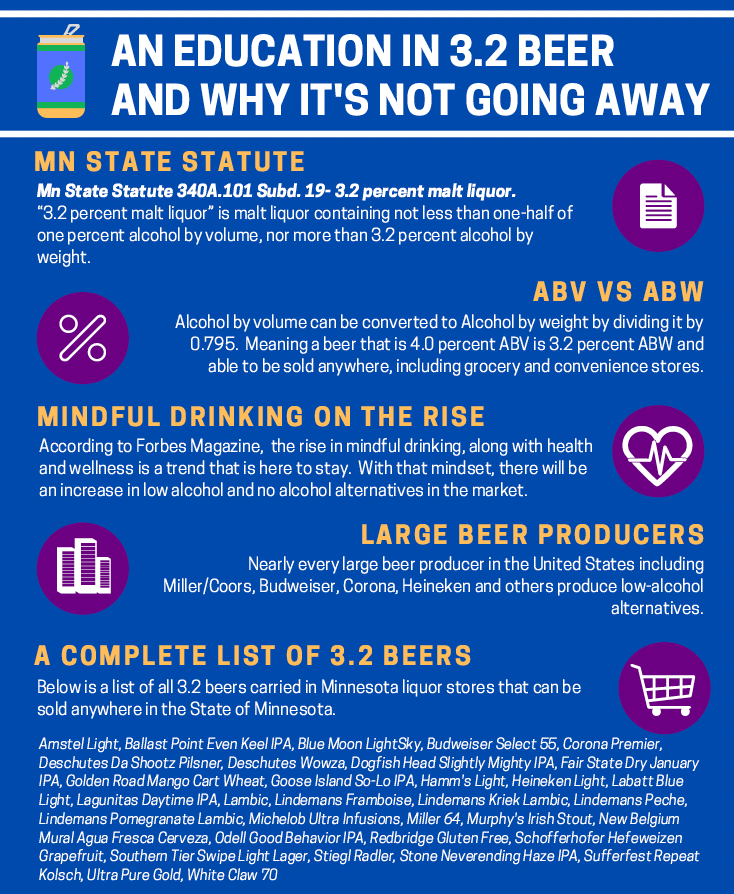
There are currently MANY varieties of “3.2” beer available as low and lower alcohol beverages are a growing trend.
“3.2” Alcohol By Weight (ABW) is 4.0% Alcohol By Volume (ABV), the measurement commonly used at breweries and labeling.
Every state sells 3.2% ABW/4.0% ABV beer.

Session beers, which generally have less alcohol and lighter flavor, are gaining popularity, Minneapolis Star Tribune, April 15, 2018
Brewers are ready for the low-ABV revolution. But are beer drinkers?, City Pages, February 6, 2019
More evidence ABVs are trending down: From City Pages Minneapolis: "As far as the greater industry, I think there is gonna be a natural trend towards lower-ABV options," said says Matt Schwandt, Bauhaus COO and head brewer.
Bar owners ‘will have to boost low ABV options’ to attract Generation Z, The Drinks Business, February 4, 2019
“This reasoning goes a long way to explaining the success of drinks companies such as Seedlip, which produce non-alcoholic spirits that can be used as a substitute for vodka or gin. “They don’t want to be infantilised,” McConnell said. “They want to feel like they’re part of the same night out, just without the alcohol content.”
“If bars want to keep that clientele they’ll have to boost those (low ABV) options,” Johanna Gerhold, Google’s industry head, said.
Letter to the Editor: Changes to 3.2 beer laws will hurt consumers: Mankato Free Press, January 29, 2019
“The recent editorial by The Free Press, “3.2 beer: A Minnesota staple fades away,” repeats several myths regarding supermarkets and convenience stores that “have long been limited to 3.2 beer.”
Grocery and convenience stores can already sell beer, wine and liquor (in separate stores on location). As long as they follow the existing smart and balanced liquor store laws, there is no legal impediment. In fact, over 161 stores in Minnesota already do, including Cub Foods in Mankato, Hy-Vee in Mankato and Sam’s Club in Mankato.These stores — in every corner of the state, urban and rural — abide by current regulations to avoid minor access and provide consumer convenience.
Easier access to alcohol, a controlled substance, shouldn’t available to those under 21. Liquor stores typically prohibit anyone under 21 from entering the store and employ people over age 21.
Consumers currently have unprecedented product availability and choice, from 3.2 beer to craft brews, wine, and liquor. Changes in our proven system could have serious repercussions for consumers.”
Minnesota businesses work to fill increased demand for non-alcoholic beverages, November 29, 2022, MinnPost and Twin Cities Business
More and more people are seeking out non-alcoholic drinks, and they’re asking for better, more robust options. A few Minnesota businesses are answering the call.
In Minnesota, breweries, cideries, wineries, and distilleries say they’re refining their offerings to meet the demand for both alcoholic and non-alcoholic drinks.
“People who are regular drinkers want to have healthier options. They want those same flavors and perceptions that fully alcoholic fermented beverages have – they just don’t want the ethanol part,” he said.
No and low alcohol drinks category continues to grow, reaching US$10billion in value, January 20, 2022, The Drinks Business.
“The IWSR forecasts that no- and low-alcohol volume will grow by 8% CAGR between 2021 and 2025, compared to regular alcohol volume growth of 0.7% CAGR during that same period.
“While January has become a popular month for people to cut back or abstain from alcohol, interest in no- and low-alcohol drinks has increasingly become a year-round trend among consumers across the world,” says Emily Neill, COO of IWSR Drinks Market Analysis.
“To meet that demand, beverage alcohol companies have invested heavily to introduce a number of innovative new products, and many established mainstream brands have recently crossed over to develop no/low alcohol versions of their popular beer, wines, and spirits.”
Indeed, well-established brands are joining the fold, creating alcohol-free alternatives to their popular offerings. The latest to tap into the trend is Italian company Martini and Rossi.
With 58% globally drinking more non-alcoholic and low-ABV cocktails than a year ago, according to the 2022 Bacardi Cocktail Trends Report, demand for premium NoLo options are expected to continue growing.”
How Low-Alcohol Beers Became Brewing's Next Big Thing, Thrillist, November 2, 2018